

Australia - On the other side of the world, in Nannup, Western Australia, the best gravel riders in the sport battled for the rainbow jersey over the weekend of 10 and 11 October. In the men’s race, defending champion Florian Vermeersch went after back-to-back world titles but found Denmark’s Magnus Bak Klaris too strong on the day.
📸 Images: Belga Image

A true war of attrition
For most Europeans, this was an expensive trip with plenty of jet lag to show for it. Recovering from that and finding good legs straight away was a challenge in itself. The course was far from flat, with 3,713 metres of climbing over 144 km for the men. With 85% of the route on unpaved roads, it was a relentless string of short climbs, with some pitches averaging up to 10%.
Everything pointed to a race of attrition, with only the strongest in line for the top step of the podium. The winner eventually crossed the finish line in 4 hours, 9 minutes and 5 seconds, maintaining an impressive average speed of 34.7 km/h.

Vermeersch meets “Danish Dynamite”
Reigning world champion Florian Vermeersch paid for the trip out of his own pocket in an attempt to defend his title. On paper the course might have been a touch too hard for him, but a rider of his calibre was more than capable of making it work. From the gun, Lukas Pöstlberger, Peter Schulting and Jenson Young were given the green light to go clear. Their lead stretched to around three minutes, but in the second half of the race the real favourites bridged across, with European champion Mads Würtz Schmidt doing much of the pace-making.
The message to Vermeersch was simple: stay on the wheels, survive, and sprint for the win. The plan worked perfectly up to a point, but in the end Bak Klaris had the most left in the tank. By his own admission, Vermeersch picked the wrong side in the sprint and finished second, understandably disappointed. Connor Swift completed the podium, and Würtz Schmidt took fourth, all on the same time. Germany’s Paul Voss, riding in Bioracer kit, came home fifth, 7 seconds back, and Stan Dewulf took a solid eighth.

Belgian blue paints the age groups
If you were looking for rainbow jerseys on riders in Bioracer kit, the age-group races were the place to look, and there were plenty. Riders in Belgian blue were regularly the strongest. Laurens Boons (19-34), Thomas Sprengers (35-39) and Kim Knaeps (40-44) all pulled on the rainbow jersey. Liesl Meeus (19–34) claimed silver, while Kenneth Mercken (50–54) secured bronze, adding two more podium finishes to Belgium’s tally and flew home with great results.


Vos solos to her fifteenth world title
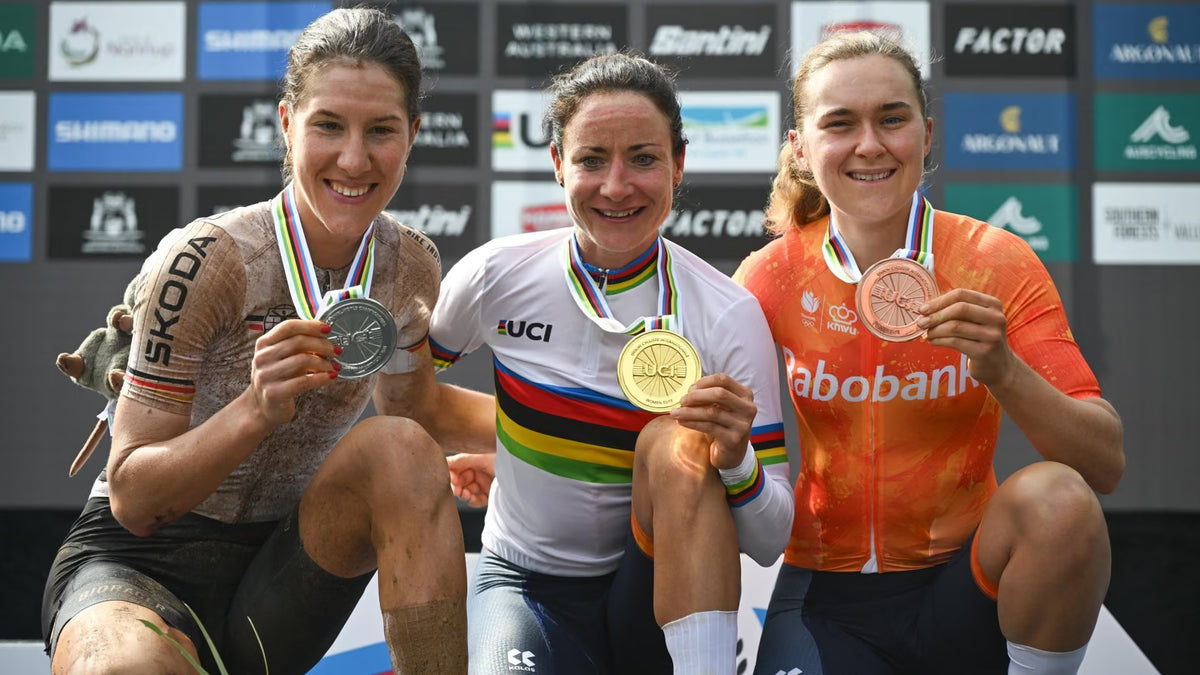
In the women’s race, Marianne Vos rode the final 4 km alone to the world title after Germany’s Rosa Klöser crashed in the finale. Klöser had also suffered a puncture earlier in the race. With 20 km to go, Vos and Klöser had broken clear together on the Glacier Climb, where they showed they were the strongest in the race. It was Vos’s second gravel world title and the fifteenth of her career. Truly remarkable. The first Belgian woman home was Joyce Vanderbeken in 15th.

Every second counts, even on gravel
Vermeersch, Bak Klaris, Swift and Würtz Schmidt crossed the line after more than four hours of racing on exactly the same time. The difference between gold and silver was decided in the final metres. It proves that the smallest details matter not just on the road, but on gravel too.
That’s why Florian Vermeersch lined up in the Epic Road Race Suit, built for top-level racing with a focus on aerodynamics, compression and comfort during long, high-intensity efforts. The Speedwear Aero Socks complement it perfectly, reducing drag around the lower leg.
Whichever discipline you choose, making you faster is our mission. Every second and every gram of energy you save is a gain, and that’s exactly where our range delivers, time after time.